Santorini’s attractions are among the most famous in Greece. It is worth visiting at any time of year. It’s famous for dreamy views, romantic sunsets, and a remarkable history. Here you’ll find those iconic whitewashed towns, dramatic cliffs and unusual beaches — black, white and red. It’s a place that stays with you forever.
Greece, Santorini – Interesting Facts and Practical Information
Santorini is part of the Cyclades archipelago in the Aegean Sea. It’s in the European Union, visa-free for EU citizens, and the European Health Insurance Card applies.
The island was formed around 3,600 years ago by a powerful volcanic eruption. When the volcano’s cone collapsed, it created a vast water-filled caldera — the reason Santorini has its distinctive crescent shape curving around the bay.
The name “Santorini” dates back to the 13th century and derives from Saint Irene.
The island’s signature look is compact white architecture topped with blue domes. As Santorini sits in a seismic zone, these domed roofs are both safer and help with air circulation.
Getting around: hire a car or use the reliable local buses. There’s a bus from the airport to Fira, the island’s capital and the main interchange for routes to other towns.
Accommodation in Santorini: There are so many accommodation options in Santorini that can make your head spin!
Staying connected: review roaming fees of your mobile phone provider and consider getting an eSIM for Greece – that’s the easiest and best option to stay connected.
Santorini Attractions
Santorini beaches

The most beautiful and most distinctive beach on Santorini is Red Beach (Kokkini), located near Akrotiri. It’s known for its intensely red cliffs and black volcanic sand that together create an incredible contrast with the turquoise water. Because of landslide risk, you should be cautious when visiting — some sections are closed to tourists.
From Red Beach or from other small ports, you can reach White Beach (Lefki Ammos) only by sea. The beach is surrounded by steep white cliffs. It’s a small stretch of dark volcanic sand mixed with pebbles, and the surrounding rock formations give it its unique appearance. It’s an ideal spot for swimming and peaceful relaxation.
Santorini is also home to several Black Beaches — a name referring to volcanic beaches with dark sand, such as:
- Kamari – located in the town of the same name, around 10 km from the capital, at the foot of the impressive Mesa Vouno rock;
- Perissa – also in the town of the same name, about 12 km from Fira, on the opposite side of Mesa Vouno;
- Mesa Pigadia – near Akrotiri, more wild and quieter than the previous two.
Other interesting beaches on Santorini include Vlychada, near Akrotiri, with striking white cliffs, and its natural extension — Eros Beach. For travellers who prefer wild, secluded spots, a great choice is Cape Columbo, located about 9 km north of the capital.
Oia – Santorini’s Most Picturesque Town

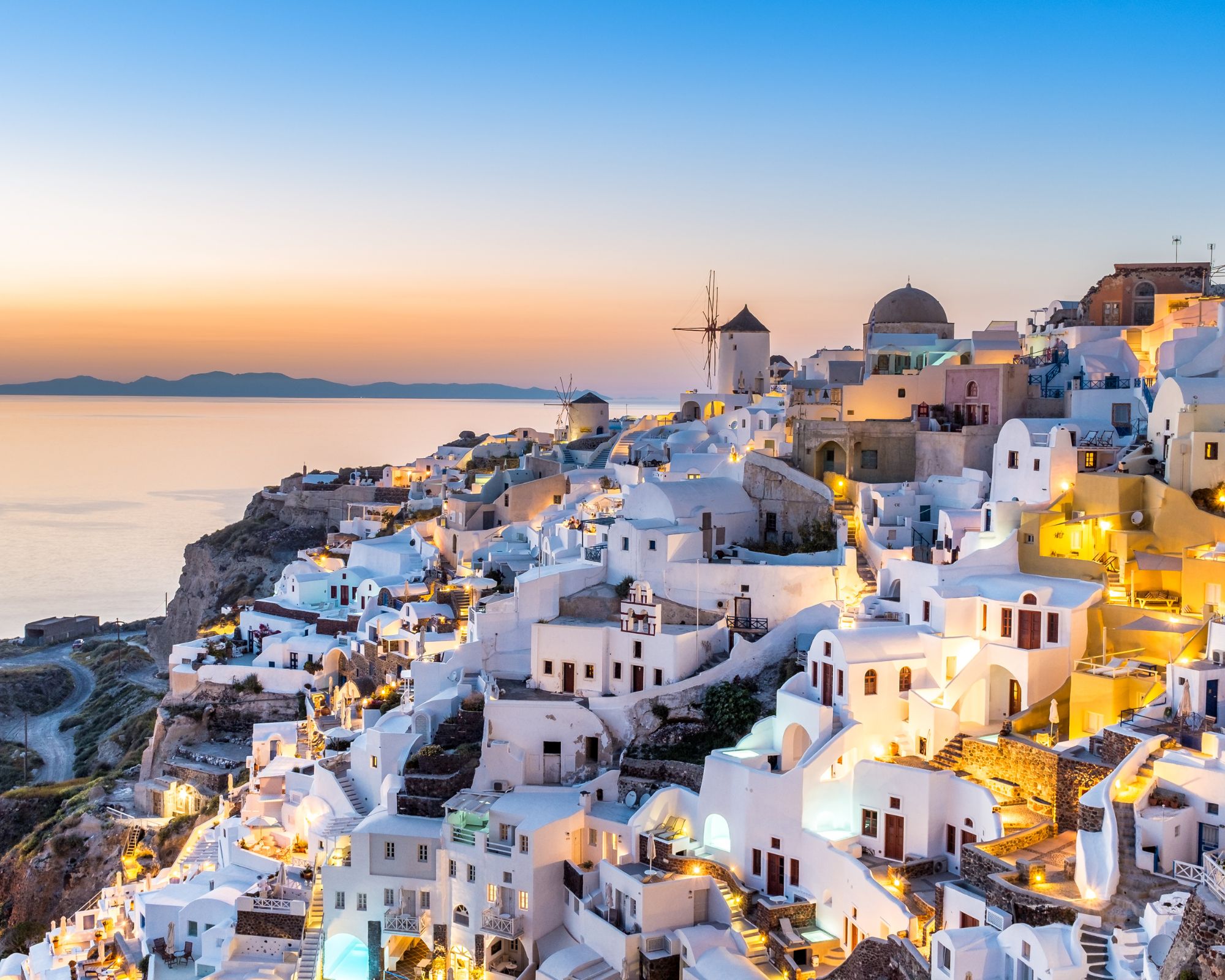
Oia is a town in the northern part of the island, built at around 150 metres above sea level. This is where you’ll find the iconic white houses with blue domes that give the town its unique charm – and appear on all the postcards. Here you can admire houses carved directly into the volcanic rock, as well as tiny chapels that look as if they are balancing on the edge of the cliff.
A walk along the narrow, cobbled alleys will let you discover Oia as a town full of art galleries, artisan workshops, churches (there are more than 70 of them!), and charming cafés and souvenir shops. Outside high season, you’ll find most open places along the main promenade – Nomikou.
One of the most important landmarks in Oia is the Panagia church, perched on a cliff overlooking the caldera. The view from the square in front of the church – and the interior with its paintings and icons – makes a strong impression. Another characteristic feature of Oia’s landscape is the historic windmills, once used for grinding grain.
The entire scenery is beautiful at any time of day or year, but it’s the sunsets, watched from the cliff, that leave the most unforgettable memories.
The Santorini Caldera
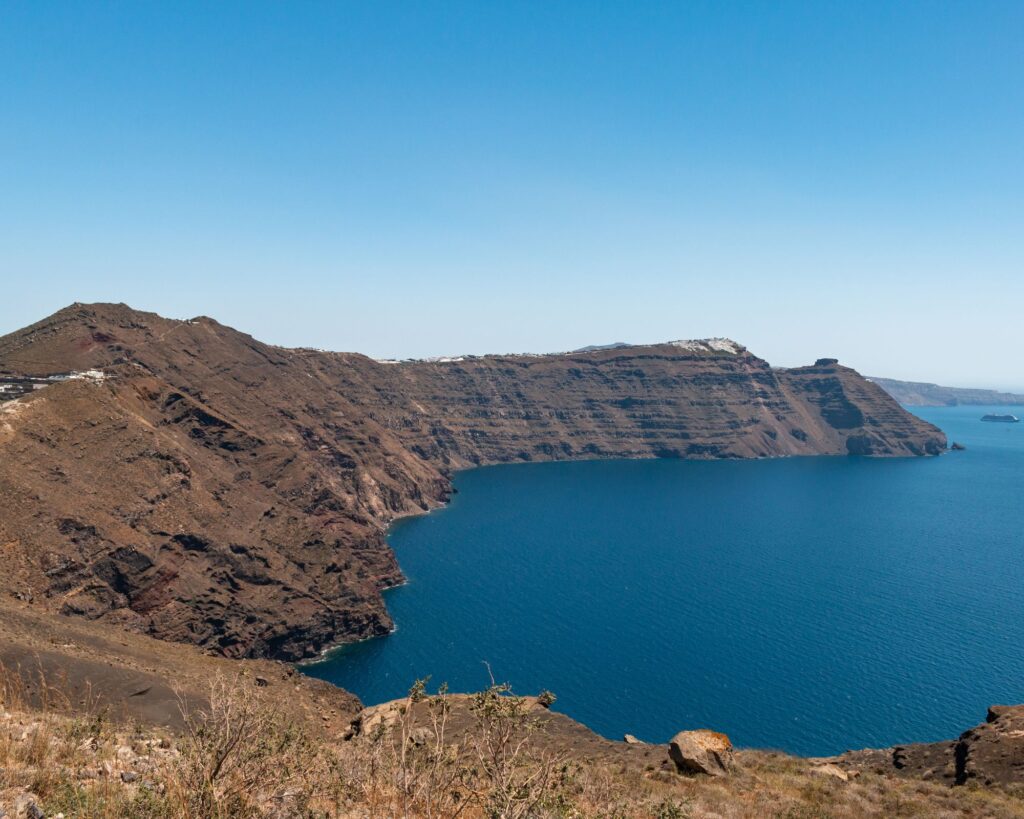
The Santorini caldera was formed as a result of the eruption of the Strongili volcano. This was the name of the original island before the powerful explosion (around 3,600 years ago) caused most of the island — together with the volcanic cone — to collapse below sea level.
The resulting depression, 10 km in diameter and up to 350 metres deep, is one of the largest calderas in the world. The caldera is now filled with water, and it is exactly this combination of deep blue sea and white houses hanging on the cliff that creates such a unique impression.
Exploring the caldera includes hiking along the cliffs — especially the picturesque trail from Oia to Fira (approx. 10 km) — as well as boat trips inside the caldera. During these cruises, the most popular attractions are visiting Nea Kameni, the volcanic island in the centre of the caldera, and Palea Kameni, the island with hot sulphur springs where tourists can swim.
Fira (Thira) – Capital of Santorini Attractions

Fira is the cultural and commercial centre of the island. It is also known as Thira, although this is simultaneously the official Greek name of the entire island of Santorini.
The town is located in the middle of the island and has served as its capital since the second half of the 18th century. Fira sits on the cliff at an altitude of 260–400 metres above sea level.
It is a small, charming town where you can enjoy one of the most beautiful panoramas of the entire archipelago. As in the whole of Santorini, you can admire the white houses with blue accents, but it’s also worth paying attention to the museums (e.g. the Museum of Prehistoric Thira, the Archaeological Museum of Santorini), art galleries, and churches (such as the Orthodox Cathedral, famous for its mosaics, frescoes, and bell tower).
A popular attraction in Fira is the cable car that descends to the old port, where boats arrive. Instead of taking the cable car, you can walk down the Karavolades — around 600 steps winding down the steep slope of the caldera.
It’s worth planning a walk to the nearby town of Firostefani, from where you get an even wider view of the caldera. The sunset over the Aegean Sea is just as beautiful from here as from Oia.
Imerovigli
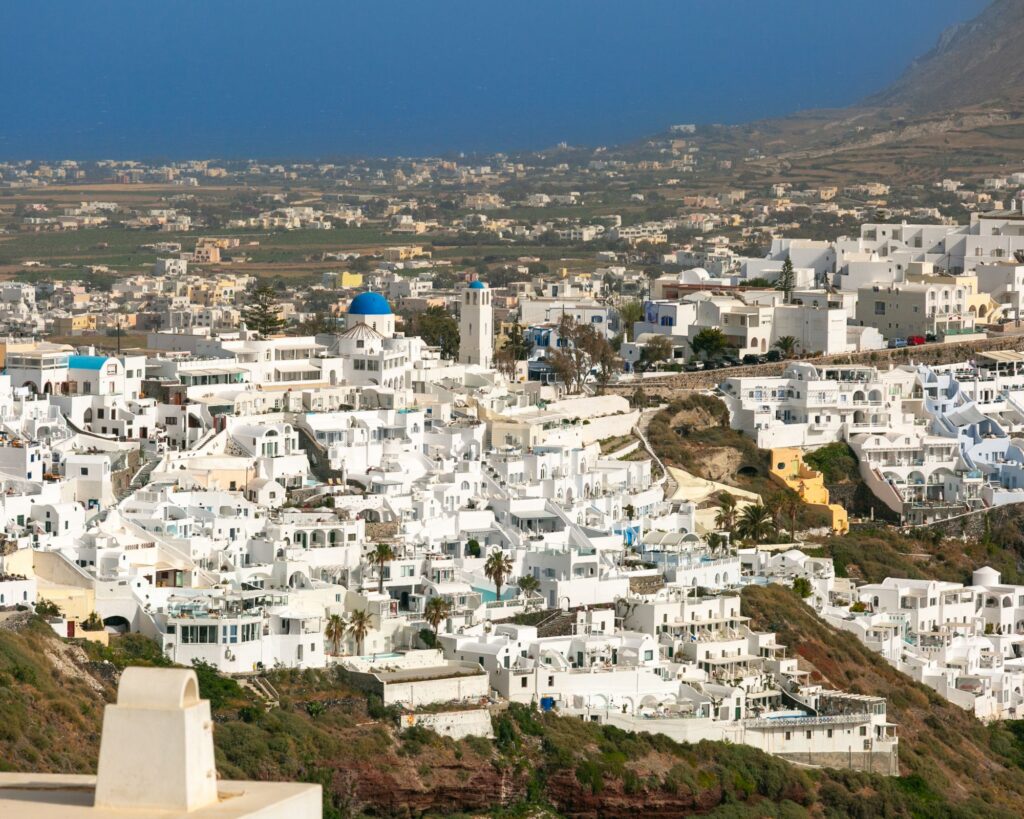
About 2 km from Fira lies the charming town of Imerovigli, famous — like the entire island — for its romantic sunsets and spectacular views of the caldera. Because it is located right on the edge of the cliff, it once served as an excellent lookout point, warning residents of incoming pirates.
The name Imerovigli comes from the Greek words imera (day) and vigla (watchpoint). The town is located along the famous Fira–Oia trekking route, which runs along the very edge of the caldera.
While in the town, it is impossible to miss Skaros Rock — a monumental rock formation on which the Venetians built a fortress in the 13th century. Skaros was one of five fortified settlements and, for 600 years, was never conquered, but it was eventually destroyed by volcanic eruptions and earthquakes.
The walk onto this rocky headland begins at the Agios Georgios church (St George’s Chapel). Walking down the concrete steps, you will pass the Agios Ioannis chapel. On your way to the very top of the hill, you can see remains of buildings and cave dwellings. Today, no one lives on the rock.
The views from the cliff, however, definitely reward the effort of the hike.
One of the symbols of Santorini is the Panagia Theoskepasti chapel, standing on the western slope of the Skaros Rock promontory. The church is dedicated to the Virgin Mary. It is a white building with a blue dome, located on a raised terrace. It has a blue-and-white bell tower with three bells. Thanks to its location, it offers a panoramic view of the sea.
Imerovigli is the perfect place for romantic walks through narrow lanes and for admiring the views; it is also a centre of yachting.
Pyrgos

Pyrgos is the highest-located settlement on the island. It lies on a hill in the central part of Santorini, which gives panoramic views over the entire island and the Aegean Sea. According to some sources, Pyrgos was the former capital of Santorini before Fira took over that role. Thanks to its strategic location (pyrgos means “tower” in Greek), it has always been an important lookout point, crucial for the island’s defence.
On the highest hill in Pyrgos stand the ruins of the medieval Venetian Kasteli castle. Beneath the castle grounds there once existed a system of underground passages which, if needed, served as shelters and escape routes.
Near the castle you will find the Agia Theodosia church. One of Pyrgos’s most characteristic churches is the historic Presentation of the Virgin Mary church, with its carved wooden altar and icons of saints.
Pyrgos is a place that has not turned into a tourist bazaar. It has its own atmosphere — a maze of lanes lined with traditional white houses and beautiful viewpoints.
Profitis Ilias – Santorini’s Highest Peak

About 3 km from Pyrgos — which is the highest settlement on the island — lies Santorini’s highest peak, Profitis Ilias (567 m a.s.l.), with the Monastery of Prophet Elias (Monastyr Prophet Elias).
The monastery, founded in 1711 by monks Joachim and Gabriel, is one of the oldest and most important Orthodox monasteries on Santorini. Today, only a few monks live here, carrying out charitable work for the local community.
Although the monastery itself is not open for sightseeing, you can enter the St Nektarios Chapel, where you can see colourful frescoes on the walls and ceiling, as well as icons. You can also walk around the courtyard. From this place, you can admire a breathtaking panorama of the island.
Akrotiri – The “Greek Pompeii”
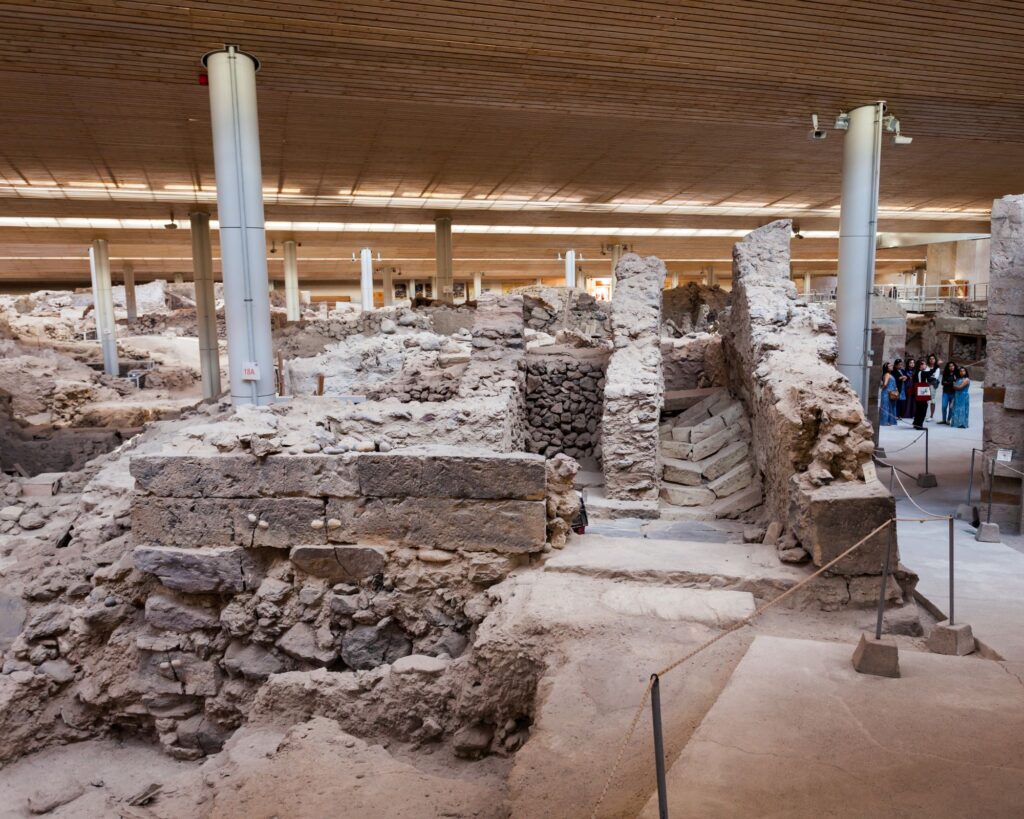
Akrotiri is one of the most important archaeological sites in Greece. It is located on the southern tip of the island, along the picturesque shore of the Aegean Sea. It is considered the “Greek Pompeii” due to the excellently preserved ruins of a Minoan town, buried in 1627 BC under volcanic debris.
Archaeologists uncovered colourful frescoes, pottery and everyday objects that show what life was like for the inhabitants 3,500 years ago. The discoveries are protected and displayed inside a modern, covered structure. Visitors move along wooden walkways suspended above the remains of ancient houses and streets.
Akrotiri is also one of the most beautiful spots on Santorini, known not only for its rich history but also for its stunning scenery.
Santorini is a place that brings history, nature, and culture together in one. It is definitely worth adding this island to your list of travel destinations.
Would you like to visit other interesting places in Europe? Check also:
Italy Off the Beaten Path: Highlight Lesser-Known Destinations
Weekend in Rome, Italy: 2 days sightseeing itinerary
Your Perfect Itinerary For Two Days In Lisbon, Portugal
How To Spend An Unforgettable Weekend In Paris? Full Itinerary.